Wednesday, August 19, 2009

Other Gardens

My back has been on the fritz this week so I have spent quite a bit of time on my back reading. I have been re-reading The Tales of the City series of books from my youth by Armistead Maupin. I lived in San Francisco when Armistead was writing these as installments in the San Francisco Examiner. They are a commentary on the lives that many of us led at the time and it is all so much fun to regain entry into that past. Soon after Harvey Milk and Mayor Moscone were assassinated many of us felt that the dream was gone and we left San Francisco.

I returned to Los Angeles, where I had, mostly, grown up to re establish my life there as well as what was to be my first in-ground garden. My first garden, I had kept cymbidiums on the fire scape of my San Francisco apartment, no doubt against the law. These large orchid plants loved the cool evenings and the often sunny days in The City.

The return to Los Angeles was not easy or direct. I had tried, in vain, to reestablish a romance in Brussels where I spent better part of a year. The return to Los Angeles took me to my mother's large apartment in Atwater. This section of Los Angeles was known for its unusual Egyptian styled houses and as the home of the old Franciscan Pottery. The move home was a difficult one. I had to admit failure and regroup. Fortunately, my mother saw this as a great opportunity for us to be together. She and I became best of friends and developed the best relationship imaginable. I did not linger long in any depressive state. I was almost 30 and there were worlds to conquer and a house to buy.

I had given myself a deadline to buy my own house by saving what amounted to $300 a week until I raised $15,000 for a down payment. The sum would take almost a year. In Los Angeles you could still buy houses for a reasonable sum of money in the early 80's. I wanted everything and had very little to spend.

I spent weekends with various Realtors. They all showed me houses with questionable wall paper, carpeting and chandeliers but their pitch was always about how wonderful all these amenities were. The houses were shit but in their mind the wallpaper, carpeting and chandeliers made up for it. I realized that I would never get much so I would have to settle for location, character and possibilities and in March 1982 I saw such a house.


The ad in the paper described it perfectly "arty hill-top home." It was a mess! Did I say it was a mess! It sat on a small flat footprint at the top of Alvarado Street at the Corner of Cerro Gordo (fat hill in Spanish). It was a few blocks away from the silent movie era Hal Roach studios where the Laurel and Hardy and the Keystone Cops had chased pianos and each other in those incredibly steep hills. It had a view (on a clear smog-less day) of all of Los Angeles from the Hollywood sign down to Catalina Island.

Louise Martinez, the owner, was by any description a Bohemian. She had quite a flair and saw in me either as a sucker or someone to take over her hill-top kingdom. The house was in no condition for normal bank financing so she had managed to put together a package to finance it herself and live off the interest. I was young and crazy enough to find the deal and the finally agreed price acceptable - $75k. I gave my down payment and had a very little mortgage to pay off; although I had everything in the world to do, to make this house and its future garden mine.

The house had a few great panes of glass that once opened up would take in the views. There was a large Agave americana that took up two parking spaces. Huge patches of Opuntias that produce the cactus apple and the nopales favored by Mexicans clung to the dry hilltop rock hard clay terrain. The beautiful powder blue Plumbago was the groundcover. Masses or a very tenacious reed existed in on the slope where I later found out the sewer leaked. Three or four old Eucalyptus had been butchered and I thought they might recover. There was a massive overgrown patch of irises that smelled of salami. The piece de resistance was a hedge about 130 feet long of Jade Plant. It stood about 4 feet tall and mostly encircled the front of the property. When I first saw the house it had been in bloom and it looked like it had snowed in LA.
Everyone I knew thought I was crazy for taking this amount of work on. Yet, I did and I still get the same reaction from new friends when I propose new ideas or far flung projects. I have, by destiny and reality been given opportunities to have choices. I have tried to make lemonade out lemons. Sometimes the ade has been sweeter than others but while I have been trying it has been fun. I am not much into laying about and doing nothing.

As an aside which got me to Blog on this topic, I had mentioned re-reading the Tales of the City books. When that series was made into an American Playhouse PBS production it was filmed down the block from my old house. Sometimes in life you get a complete circle...


Wednesday, August 12, 2009

Say What?

Downpour in the Garden

On August 8, Michael Bruce and I were featured in an article in the Courier Post about two gentlemen who had “cut out their lawns”. The article entitled “Shaggy Gardens” by Renee Winkler http://www.courierpostonline.com/article/20090808/LIFE02/908080301 (goodluck getting to website) is a term quoted from a conversation between the author and me, that describes part of my philosophy on gardening: Gardens look best when they are not manicured and have a leftover shaggy look. The article although flattering in nature did not mention much about why two plant professionals, a renowned florist and a landscape architect, might have chosen this approach. Having drinks with my friend Elena, she complained about missing context. Her mind, that of a lawyer, immediately went to the crux of the matter on what was missing from this article. The history of lawns and the statistics of lawncare: pesticide overuse, acreage allocation, energy utilized to maintain.


I understand why a local newspapers might not want to deal with hard facts instead of feel good stories: decline in circulation, apathetic public, etc, etc. I am not a professional writer, nor am I making a statement on the writers and editors of this article, but it makes you wonder why bother writing a meaningful story and then place it on the Saturday paper if you can’t give your writing public something more than fluff and pictures?


Lawns in America are the democratic response to a European leftover practice employed by farmers and nobles alike that started in the Middle Ages. The word lawn is an old English and Dutch derivative place name where animals went to graze. These naturally occurring Lawns were maintained by grazing animals (horses, sheep, cattle or other livestock) and were made up of multiple species of plants and grasses (like meadows). Nobles enlarged their domains by bringing the lawns close to their houses for the natural landscape effect and using animals as lawnmowers! With the invention of the push lawnmower in the early 1800’s the expanse of lawns grew from what was traditionally kept by animals and an army of serfs with scythes.


The lawnmower evolved from a mechanized blade to steam, to the gasoline powered engine to the electric quieter motors and some of the solar mowers we have today. Americans did not believe in serfs and we are an industrial power so our thinking brought about a multitude of practices that eventually included: a cheap lawnmower for everyone, specialized lawn seeds for specific applications, fertilizers to make these deficient lawns grown and herbicides to kill anything other than the few select grasses in lawn mixtures to thrive.

Statistics vary but I will give you a few that I have found. For some further insight check out: http://www.backyardnature.com/cgi-bin/gt/tpl.h,content=381 . Regardless which statistics are correct, the numbers are impressive. Americans spend 40 billion dollars on lawncare and as the population ages more money will be spent.


  • 80% of all U.S. households have private lawns
  • Average American lawn is between 1/5 -1/3 acre
  • In the U.S, alone, it is estimated that there are more than 31 million acres of grass (An area equal to the New England states. Over 80% of this grass is found in residential lawns.)

Similarly, pesticides and fertilizers are a major concern to our environment and have been the panacea to the American Lawn. Concerns over the runoff of these chemicals from our lawns into our water worry many. Studies have been done linking algal blooms with too many fertilizers. Often, we turn a blind eye to many things we don’t want to understand or hear. Yet there are many concerned parents that are wondering the wisdom of bringing in a specialist lawn care provider with a chemical soup that is quickly applied to the benefit of having a rich green lawn so their children can go romping in it minutes later. As a child growing up in Cuba, we kids would wait for the moskito fog truck to come by so we could play soldiers in the mist! Wonder the chemical makeup of the fog and what effects it has left? It is no wonder that Canadian provinces and many European governments are banning the use of chemicals applications to lawns.


Finally, lawns cannot grow everywhere without major rainfall or irrigation. If you are lucky enough to live in a place where a lawn can exist naturally enjoy it while you can. With tightening water restrictions due to drought, population growth or other limitations we shall see the price of water continue to rise to levels not imagined.

I wanted to make a point about the Courier Post article that simplified my reasons for not having a lawn. I have not dealt with the time it takes for upkeep or that it is just a lawn and not more. Please note that I am not on a personal vendetta against lawns. They have a place, if a limited one. I recognize that golfers in wet Scotland invented a scenic sport around it; children, dogs, picnics and lovers need it for fun and frolic. I simply choose not to be a slave to one.

Tuesday, August 4, 2009

Meanwhile Back in the Garden


It is the first week of August and the garden seems a little spent and mainly green. We are having one of the best summers I can remember. The rain has come down in torrential buckets at times and has taken enough of a break to come back again when needed. This said, lately the rain has come a little more frequent, but given the heat the plants can sure use it. It is hard to consider but we are part of the Tropics during this season: humid, hot and sunny. Plants, for the most part love it.


A few weeks ago the garden was a lot more colorful with a sea of Daylilies towering about 4-5 feet above the ground. With a combination of Bee Balm and some straggling roses it created an opportunity artists to take advantage. The weather had been warm and dry and really wonderful for weeks on end. So outdoor lunches and visits to the garden to draw or read and relax were numerous. Often times, the only place that is comfortable in the garden in Summer is under the willow by the pond. Here, the tree canopy creates a magical breeze not found elsewhere. It was nice to regain the entire garden for outdoor activities during these weeks.


Vori installed himself on the walkway and in an afternoon cranked out a wonderful crayon-pastel rendering of the garden. Julia and I have been on his case about selling his art. He is immensely talented, but like many an artist he creates it for himself and is often unsure of how his product comes across. I can tell you he is good, very good at that. I may have to photograph some of his portfolio and put it on the blog.
Many years ago I visited a couple in the Washington DC area where I discovered a wonderful plant. The Japanese anemones grew in this magnificent wet garden near the Potomac River. Here banks of pink and white Anemones were floating, not unlike my Daylilies, on long stems with delicately shaped flowers that also resembled Japanese Irises with those floppy petals. The two ladies that called this garden home, immediately brought out a spade to split out a plant for me to take. I was thrilled and took the plant home to another garden that I shared.

The plants never grew very much in this garden because it was very sandy and they managed to grow but not like in Washington DC. Eventually, when I bought my house I dug up these puppies and moved them to a shady location but a dry one at that (see all the knowledge you think you have sometimes goes out the window!) The Anemones fared better than before but never really made a spectacular showing. Last season I dug them out, as many as I could find
and relocated them off the main bed in the back where it is sunny and wet. This year that plants have flourished and are showing many buds. With any luck it will be a good season for them as well. They should bloom later but to tell you the truth I have not cared for them closely where they were so I am not sure exactly when to expect them.

I am a glutton for work at times. I love Crotons (pictured above) but they don't like to overwinter in dark places. I grew up with them in Cuba where they were used as hedges ten feet tall. There, you could snap a branch and stick in the ground and it would grow! My Mother, in Los Angeles, had the ordinary ones you buy in grocery stores. She had bought this little ball shaped plant a foot tall and grown it to a monster of about five feet tall.

When my Mother died I brought her plants East. I felt a responsibility to continue growing something that she had cared for so lovingly for so many years. Her Malanga (a form of tropical ivy also sold in grocery stores) has managed to grow ten years after her passing. Other plants I brought from her balcony grew so large that I donated to conservatory gardens. Her Croton somehow, I managed to kill. Fortunately I managed to make enough cuttings that I handed to friends so I can at some point get a plant from the original back. Julia has one that has grown larger than my Mother's original plant. Last time I saw it it was almost 7 feet tall. I think this may have something to do with women and how they care or not for plants. I know it sounds sexist but what can you do?

So when I was visiting my cousins in Tampa I found this strange little Croton that I do not remember from the tropics. It has skinny leaves and maybe it will require less light to overwinter during our grey period. I will try and give this one a go before I lay claims to some of Julia's cuttings. I will tell you that upon close inspection it already seems to be providing home to mealy bugs so I have my work cut out.

Wednesday, July 29, 2009

One More for the Road


I never realised that we grew tea in the United States. For me tea was something exotic from far away places normally associated with Asia. As a kid growing up in LA, I came to know a wonderful family, the Rodes, from Ceylon (Srilanka today). Their kids and I grew up together and we became the best of friends. Tea was a ritual at their house in the way it was prepared and enjoyed. The family and I would sit around the porch and Esme (the mother) would arrive with an ordinary aluminum tea pot with the most wonderful concoction you ever tasted. This very strong tea would be consumed sweetened with condensed milk that really hit the spot after one of those fabulous Sunday brunches with multiple hot, hot curries and other equally delectable spicy dishes, that so marked my teenage years.

The film Elephant Walk with Elizabeth Taylor and Peter Finch was shot in Ceylon's in 1953. It shows the color and pageant of tea culture with the tea pickers going into the beautiful mountain slopes to harvest the tea plant (Camellia sinensis) which is a form of flowering Camellias. I suspect that tea culture and harvest is probably still, in parts of the world, as how it was portrayed in that movie. I also realise that it is hard work in the hot tropical sun and must not have been as romantic as it was portrayed.
So you can imagine what a surprise it was to discover that in South Carolina we have a modern tea plantation. The only one in the United States. Here plants of green tea are grown and harvested to create American Classic Island Green Tea. The plantation is large enough and fields go as far as the eye can see.

It appears to be all harvested by machine as is the entire process of prepping the leaves for market. That is also all done on site to joys of the tourists who visit individually or in tours. I stumbled on it by chance as I was looking for the Angel Oak. Signs to the plantation lead me across John's Island which is one of the larger islands on the Charleston Bay watershed.


manicured rows of plants appear to be all machine pruned which is practical given all the cottonmouth snakes in the area


This was my second stop of the day. It was a wonderful place to relax, snoop and discover along the way. I tried the green tea which was really great and refreshing. The property had a certain look of the Old South even though the tea plantation is rather recent. I sat by the fields sipping my iced green tea underneath this great old oak. Unfortunately, my stay was short as I was on my way to the Middleton Plantation where I knew I wanted to spend a lot of time. Still it was a great stop along the road. It is just unfortunate that there was not a great Ceylonese lunch to go with my tea.

Wednesday, July 22, 2009

You can't go home again

Thomas Wolfe, I am sure, did not have my friends or me in mind when he wrote his novel, but it sure comes to mind when thinking of how much life changes and attempts to regain the past fall, at times, into futile vanity.


I am not going to write about gardens today. I have neglected whatever reading public is out there for this blog while I have been dealing with unemployment, reconnecting with family and hosting a French family in my house. For many weeks I have dealt with the Blog by giving my take on historical information already out there in other places. As a friend, pointed out, (I paraphrase) you need to put yourself back into the blog and deal with your thoughts and emotions. I suspect a Blog is read voyeurism!

Here goes all.

Unemployment will come to an end one way or another soon enough. Talent and willingness to work are two things that I have and they will manifest itself in real and concrete ways once again.

Reconnecting with family in Florida was a lot of fun after ten years of separation. I got to visit my cousins and see all the things that we shared as kids in Cuba and how far that has carried us. We managed to play together as adults and have a little fun visiting new places or taking on an unexpected adventure. We have made the best of a difficult situation by being pulled out of our country of birth and dropped in another to figure it all out. To all our credit we have managed and even succeeded in adapting and laying claim to successful happy lives. It would be crazy if it were otherwise given that we have now lived here in the United States longer than anywhere else.

My trip also had another quest: Whether or not to move to Florida? As I drove through the neighborhoods around Tampa Bay I could see myself in a beautiful tropical setting where I could develop a new garden. For now, the life that I have developed in New Jersey is the one I plan to live. I have worked so hard to fit out my home to my every need. I have developed a garden that I take a great pleasure in seeing it grow. Most of all I am afraid of that the amount of energy it took to get it all done and the ability to keep starting anew.

Sometime last fall I rediscovered (through the magic of Google) a girlfriend from my youth while at the University in Montpellier, France. I was delighted when she informed me that she and her family were coming to the States to visit and see me. Maybe in translation I failed to understand that they were just coming to visit me and extended and open invitation to stay at my house for as long as they wanted. I was later informed that they were coming to stay for 24 days. We corresponded and exchanged information on places to visit and where they might go. I also offered to serve as travel guide and take them around to a few places as it would be difficult, with job hunting, to do more. I had thought the first week would be spent around Philadelphia, week 2 around Washington and New York City and week three we would visit upstate NY and Niagara Falls. I also figured they would travel some places on their own; I figured wrong!

The wonder of their visit quickly vanished when they set up housekeeping as though they would never go anywhere but just sit and chat and take in the odd site here or there for the duration. Our first fiasco occurred when I took them on day 4 to the Statue of Liberty and it was crowded by the usual mobs that cling to tourist site here and abroad. My old friend found herself a little uncomfortable with a very demanding husband who expected three French squares a day and had little interest for culture. Her 16 year old daughter had left a budding romance back home and she was only concerned with emailing him as often as possible. I understood this side of the French because they love good food and come from a country filled to capacity with culture so seeing Museums and built landmarks tend to have a lesser impact on them than with other cultures. For this reason I had thought that Niagara Falls was the site around here where they would enjoy themselves the most.

In reality, week one had gotten off badly after the Statue of Liberty. Other outings to natural sites fared better but it was becoming obvious that New Jersey is not France (just in case you wondered!) We had bad bread, expensive wine and expensive food. Everything as a matter of fact was expensive unlike France where they give it away! Nothing was like in France. To top it off a visit to a favorite outdoor dining restaurant was well received but put to a test when the husband wanted to stiff on the tip because in France it is included. I explained the differences and how the servers are paid little and live off the tips to little reception from the husband.

My friend had done the minimum of research but the others had not. There was no collective idea of what to do or visit or a budget for travel. It became clear that we were going to have a bad time if we did not alter the program. Week two became a test to find an escape for them where they could be together as a family without me. This, after much contemplation and budget analysis became even more difficult. I still did manage to find a respite by getting them off to Atlantic City where they spent three days and two nights.

My friend Julia, a trooper if ever there was one, who had hosted them over the 4th of July and on another occasion had already made arrangements to take them to the Barnes Foundation where we had not been and thought they would enjoy visiting with all the French art. My friend was thrilled at the opportunity. An artist, herself, she was looking forward to the visit. At last moment it was announced that the husband and daughter were not going to join us which I thought was great so the adults could have a day away from the children. Little attention was paid to the difficulty and the cost of getting tickets by our visitors. Many of you in Philadelphia would have probably wished you could have joined us in such a pilgrimage that is going to the Barnes.

The worst, however, was not over. Week three lay ahead and by this point I no longer found it charming or colorful what lay in store for me. Against, better judgment and advice I drove eight hours to Rochester where I proceeded to have a horrendous fight with the husband over tipping and other lack of courtesies and culture. I apologized profusely to my dear friend RJ who would host us for three days and who had gone to great lengths to plan a Bastille Day Party for the visiting French and his other friends and, alas, was surprised by the boorish behavior. Still we managed to continue the trip and visit to Niagara Falls that appeared to soothe our visitors.

Returning home from the trip I wavered in what I would actually do. I had told my friend that upon returning I expected them to move into a hotel for the remaining three days of their trip, but I feared all the extra work it would entail for me arranging it. Somehow, more of the same cacophony already demonstrated continued and I found myself going home to explain to a very dour friend that she and the others would need to move into a hotel. Needless, to say, I felt like shit in this request but it was more than any one person could tolerate. The next morning I apologized to the daughter who explained to me that I had only stood it for 21 days. She explained that she was "saturated" from similar behavior since her mother had married the man five years ago. I deposited them at the hotel they had chosen. No one said thank you, they just turned their backs on me and walked away.

My friend Vori had sent me an article that was timely enough. Apparently, Reuters Paris had run an article on July 9 that was carried by a variety of newspapers across the country and the world claiming the French to be the worst tourists. They cited lack of language skills, little interest in other cultures, poor tipping and spending habits and a list of other significant complaints by over 4500 hotel owners. I want to state categorically that it was 4501 who felt that way. I am sorry for my poor and charming friend, but we live the life we choose. Please don't tell me about Mark Twain and how fish and house guests stink after three days...I know, already!


Addendum:

I want to clarify one point that I failed to make about my house guest fiasco. My comments about the French was more a comment on ill behaved and socially uncouth people everywhere. I know lots of fabulous French who know what bad manners are and who are gracious and elegant! I question my own manners writing about this but will simply say this is a blog entitled: Once Upon a Garden Blog, garden experiences learned and the surprises along the way. I believe this qualifies as a surprise along the way!

Friday, July 10, 2009

Middleton Place

Plan on property showing formality of gardens and layout

Carolina was a colony founded in 1663. The two Carolinas we have now occurred in a split in 1712. Middleton Place came into being during the colonial period and was given to Henry Middleton, President of the Continental Congress, as part of a marriage dowry. A considerable plantation of its day with about 50,000 acres in rice Middleton Place today is a resort and a significant historic property and garden of about 65 acres. The historic approach to the property was by the Ashley River to which the formal layout is oriented so visitors and Master alike would get the best view of the property as they approached from Charleston.


Aerial photograph on display at garden featuring Butterfly Lakes and Central approach

The house was of Jacobean style and the formal gardens were and are rather sumptuous in their design and layout. Among the most famous features are the Butterfly Lakes which were part of the water system for flooding the rice paddies. It must be considered influenced by Versailles which was under construction and development at the same time. The continuous influence of the French during the Independence War can be seen in the gardens as well as the relationship of Middleton and Andre Michaux (who was eventually Royal Botanist to Louis XVI) who, as a consequence of their friendship, sent the first Camellias in the United States to the plantation.

Middleton family influence with the South and cessation from the Union caused the property to be targeted and the Mansion and the property to be burned in 1865. What remained was further damaged by the Great Earthquake in 1886. Since then, the family fortune has allowed, with help of all manner of enterprise, the restoration of the property. Today, Middleton Place operates as an elegant southern resort with a beautiful inn where guests have access to the garden. Most of what was plantation has been developed by neighboring communities and Charleston. Along Ashley River Road are two other well known historic properties also open to visitors: Drayton Hall and Magnolia Plantation. These offer modern varied views of how historic plantations are managed: one more historic and the other more commercial.


Modern Archway leads into a definitely historic landscape


Formal pathways framed by trees, azaleas or camellias with focal gateways are the norm


Moss covered views and brick perforated walls framing edges


Multi-purpose water features were used to manage rice paddies. Today they serve the local alligators and tourist for photo vistas


Wood Nymph was hidden and survived the assault of the Union Troops


Modern installation near restaurant serves as an overlook on old Rice Mill and Pond

Remaining entry stoop to the Mansion which as you can see was never rebuilt


View of formal parterre from Middleton Oak


I did not photograph the Middleton Oak as I found it sadly deformed by its loss of limbs. The tour guides at Middleton Place speak of it with great reverence and claim it to be larger than the Angel Oak featured in my last blog. I borrowed these images from the Comtesse de Sparr (above) and Joel8X (below) to give you and idea of what it is and what it was. You decide if it is grander than the Angel Oak. Personally, I think the Angel is grander and certainly older whether it is one trunk or ten!


Middleton Place is certainly a marvelous garden to visit and I hope one day to stay at the resort. My visit in June was rather late in the season and hot. Few plants were in bloom and I was rushed to see the gardens and skip the museum and slave quarters. I highly recommend that when you visit you prepare yourself for a stiff garden admission price of $25.00 (more if you visit the other historic structures) and that you do it in the vicinity of Mother's day. Then, you will enjoy the thousands upon thousands of Camellias, azaleas, and roses that abound in the garden it will also be cooler with any luck. It is a magnificent place. Regardless you will enjoy its beautiful location and hopefully you will explore a back path to the Cypress Lake where the terrain appears as though barely been touched by man or time.


Tuesday, July 7, 2009

Wonders Along the Road

It is not everyday that you get the opportunity to travel along these kind of roads in places that exist in the mist and the history of the past. Yes, we live in modern times, but when you really take account, some of the best things about us are in our history. As I was driving to Charleston I could not cease to stop here, there and everywhere to look at what was before me that even at a slow drive was passing by way too quickly. The results of these stops provided me with some of the greatest discoveries. I tend to read anything and everything historical and sometime ago I had read of the Angel Oak.

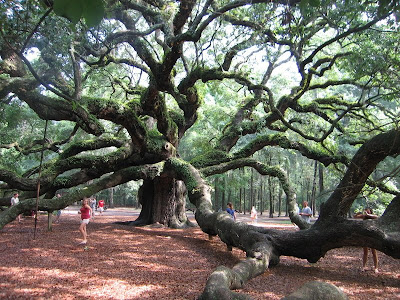
This Southern Live Oak (Quercus virginiana) tree is approximately 1400 years old. It managed to survive Hugo that severely damaged a section of the tree, but it has managed to recover and continues to grow rather well. Even though the canopy in partially damaged, you still manage to see a magnificent specimen tree which has limbs that flow in the air like feathers to lenghts of 90 feet. Newton was right about gravity but seeing 90 foot horizontal limbs floating in air makes you question what is subject to gravity? In all the tree takes up about half an acre of land. It is monumental without question even though the Middleton Oak (stay tuned until next week) is purported to be the largest single trunk whereas the Angel Oak is supposed to be multiple trees that grew together to become siamese triplets or whatever. I can't tell how anyone can tell, but I will go along with the story.

The truth is that regardless of what you call it the tree is a marvel of nature that has managed to survive in a culture that is often more interested in lumber than in trees. Take into account the number of hurricanes that have tested its buttressing limbs or the fact that its swampy location on John Island would be the death knell of many another plant, it has survived to become the oldest living organism east of the Mississippi River.
Visitors of every language were there to view and photograph the Angel Oak whose trunk is covered in Resurrection Fern (Polypodium polypodioides). Aptly named for it will wither and disappear when weather fails to provide it with the required moisture. When rain falls the seemingly dead branches unfurl and create lush green carpeting that so typifies it.
The secondary epiphyte that lives on the oak is Spanish Moss (Tillandsia usneoides). The moss and the fern both use the tree only for support and as a place to collect water, nutrient and air which they both require. Unfortunately as they grow they place additional weight on delicately balanced limbs. Sometimes the two epiphytes are removed to lighten branches in peril. As you can see some branches are now aided by the support of metal columns. This practice is often questioned as whether it is beneficial or not. For now, they have been used to stabilize the tree.
Parting to another destination I stopped by the mailbox to look upon it one last time. The tree which was taken over for protection by (not-so-near) Charleston now has a sort of visitor center where locals weave the famous Charleston Baskets. Efforts are to raise funds to maintain and protect the tree without charging admission. I hope these continue to safeguard its beauty which when seen from afar is not very different from the rest of the neighboring forest. No doubt this has also helped to hide and to save it.